
Reaction wheels
Coverage breaks where the track curves — only the straight segment is captured.

More coverage - Single pass
Pyramid Mini CMG configuration gives a 500 kg class imaging satellite the torque to re-orient several degrees per second, capturing target after target without excessive wait time waiting for the spacecraft.
Reaction wheels can hold a line but cannot re-point fast enough to follow the corridor. The mini-CMG keeps the sensor on terrain through the turns, stitching one continuous strip.
Coverage breaks where the track curves — only the straight segment is captured.
The sensor tracks the corridor through every turn — one unbroken multi-strip pass.
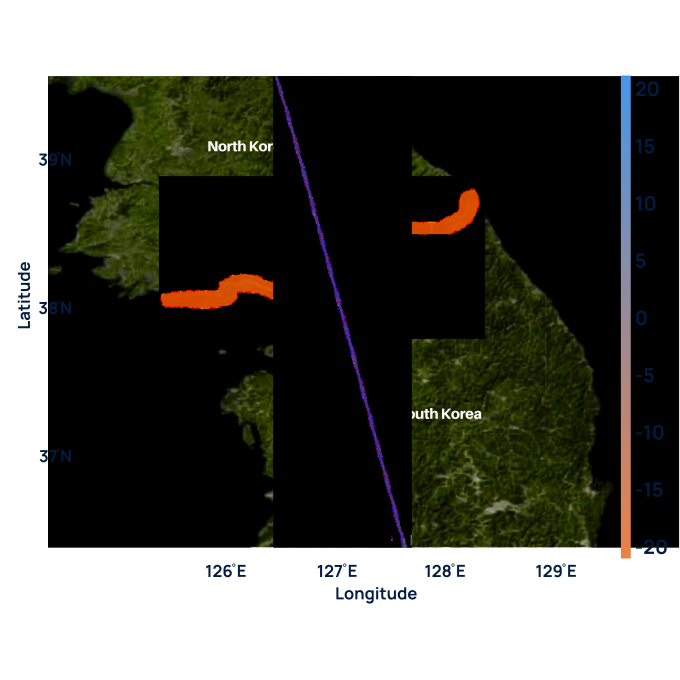
The reference mission demonstrates an operational orbit at an altitude of 535km. Utilizing the spacecraft dynamic context for every segment to track standard scenario targets within country.
| Orbit height | 566 km |
| Inclination | 97.6 deg |
| LTAN | 10.30 |
| Repeating ground track | ~15 orbits |
| Orbital period | 96 min |
| Sensor swath on ground | 10 km |
| Vehicle inertia | 100 kg·m² |
Both actuators fit the bus. What seperates them is how hard they can push: the mini-CMG cluster delivers the torque to slew the spacecraft between targets in under a second - at a fraction of the peak power.
4-GIMBAL CLUSTER · TORQUE-AMPLIFYING
~15×
4-WHEEL CLUSTER · DIRECT-DRIVE
~10×
The advantage over reaction wheels comes mostly from raw torque capability — but torque alone is not enough. It has to be paired with a steering law that maps each commanded torque onto gimbal-rate commands while staying clear of singularities. A jerk-limited reference profile keeps the maneuver smooth; the VEO steering logic keeps the cluster controllable.
Send us your inertia, target list and duty cycle — we'll size the cluster.