
In space, there is nothing to hold on to. If a spacecraft needs to move or turn, it cannot simply push on something else to do so.
In order to allow spacecraft to change their orientation in a reasonable amount of time, designers have two main options at their disposal.
The most well-known from the general public is certainly the use of thrusters. Thrusters burn fuel or simply eject stored gases at high speed to produce a force. Thrusters can be very powerful, and are able to move spacecraft very fast, but have (at least) one obvious limitation. They need fuel to work, and since they are no gas stations is space yet, they end up running out.
The other option, used by the majority of satellites, is momentum exchange devices. Momentum exchange devices are a family of actuators that are based on the law of conservation of angular momentum, and can produce torques directly without requiring any fuel (except electricity). We distinguish two categories of momentum exchange devices based on how they produce torques.
- Reaction wheels accelerate a flywheel to generate torques
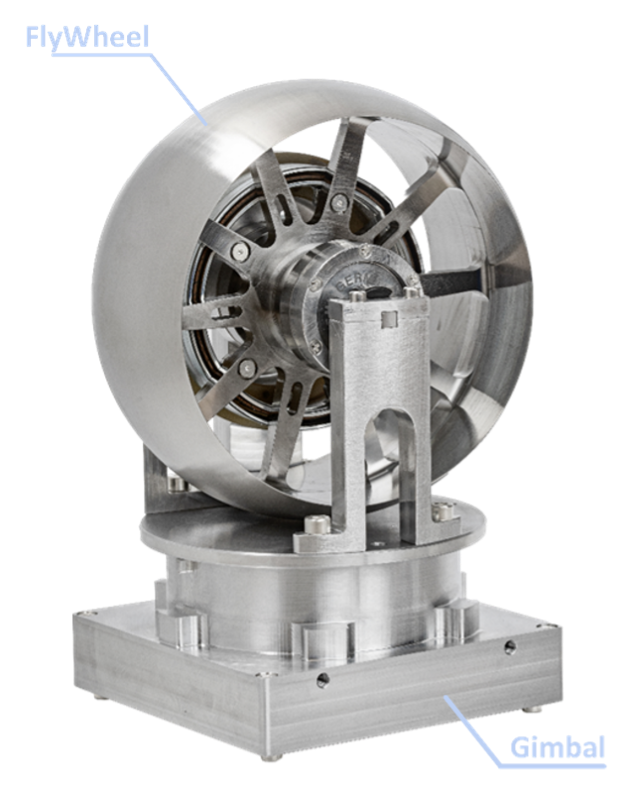
- Control Moment Gyroscopes change the direction of a spinning flywheel to generate gyroscopic torques
Although the technology differs, both categories involve the use of a flywheel, and the exchange of (angular) momentum with the spacecraft.
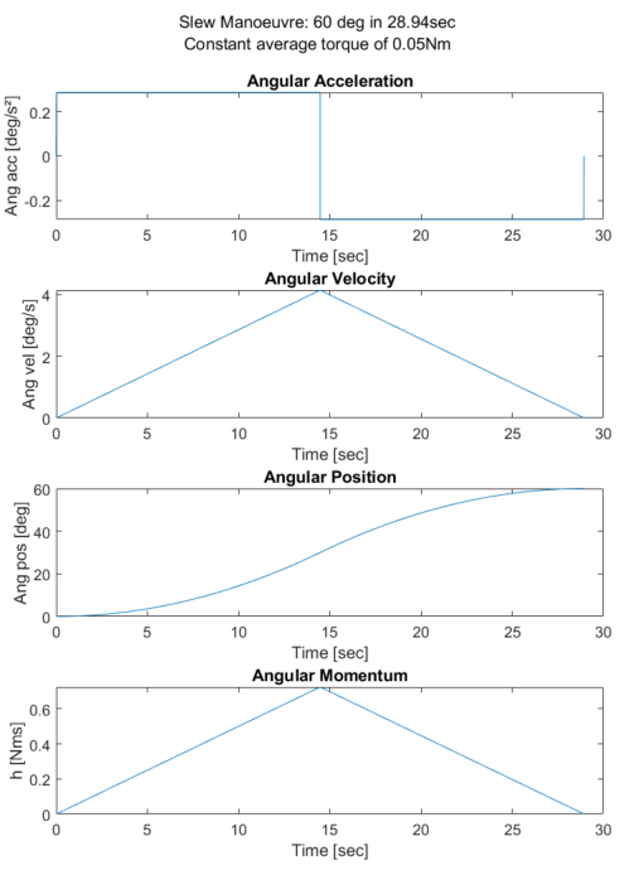
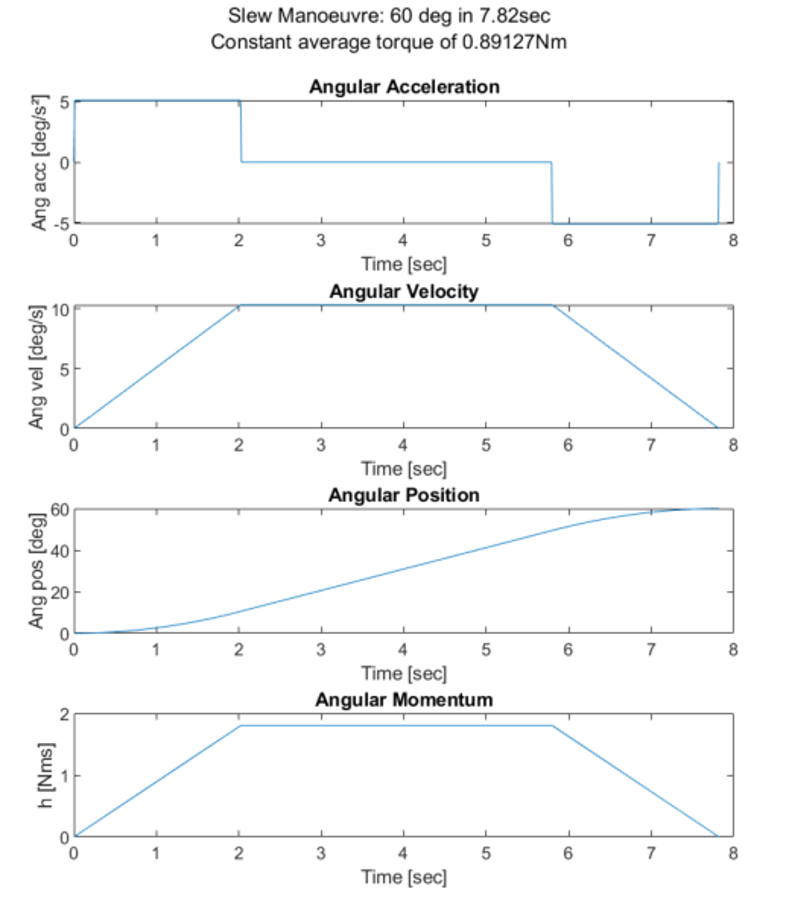
Technically, the accumulation of angular momentum is generated by the production of a torque for a certain period of time. As these devices do not use any fuel, and do not eject any mass or energy, the total momentum on board the satellite does not change. This means that the movement that is imparted on the satellite (and it’s momentum) is compensated for by a momentum stored in these devices. Since momentum is conserved, it is in practice always transferred from the spacecraft to these devices and vice versa, hence the name momentum exchange devices.